Original topic illustration: ChainView BTC866 original topic diagram · ChainView BTC866 Editorial · CC BY 4.0
Mechanism and rights
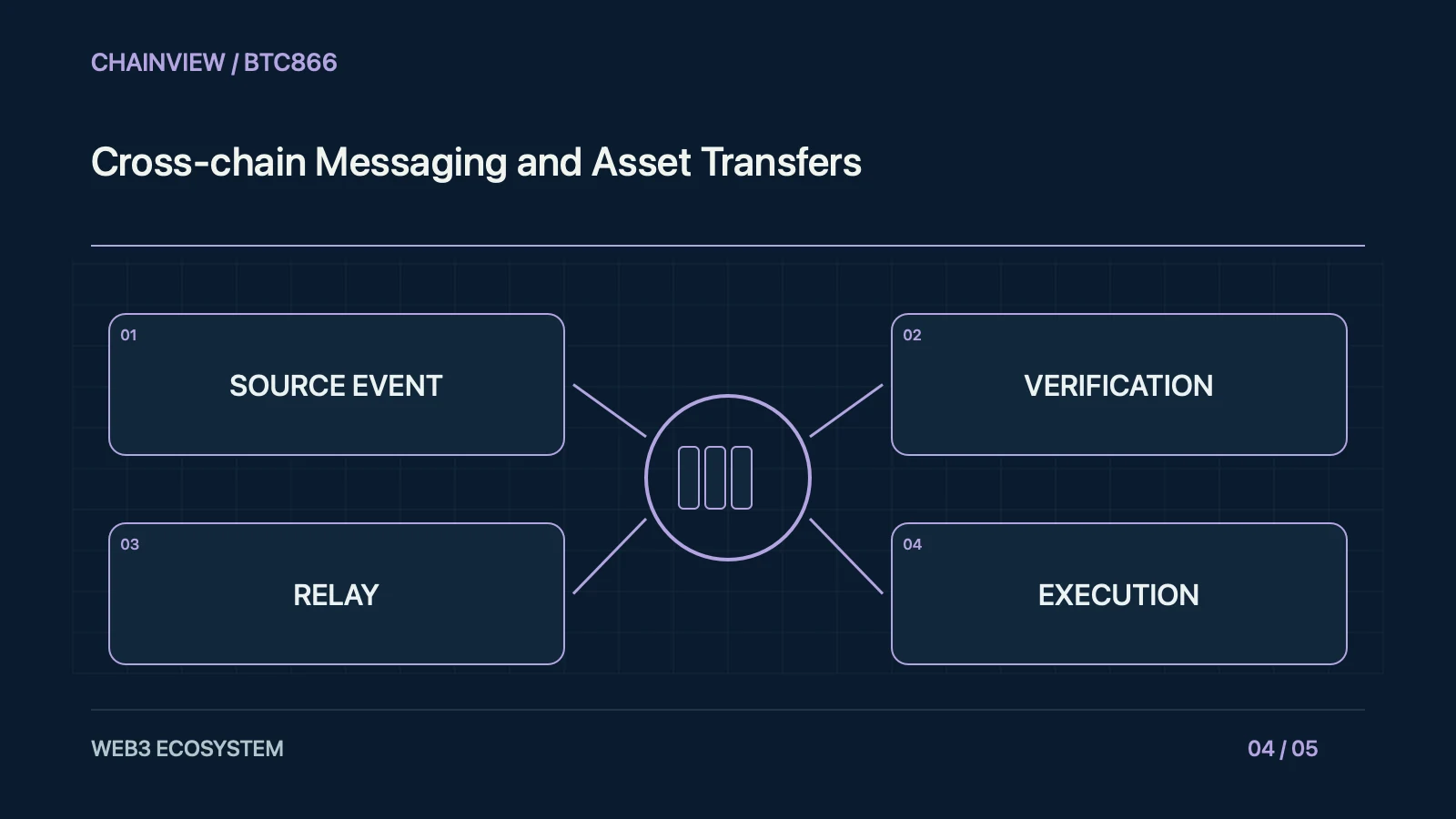
Cross-chain messaging transports claims about source-chain events or state. Token bridging is one application, while governance, data updates, and contract calls can use messages without transferring tokens. Map emission, verification, delivery, and destination execution separately. Identify the proof mechanism or verifier set at each boundary. A provider brand does not establish one uniform security model across all products, networks, versions, or deployment configurations.
Mark which portions of the route depend on chain consensus and which depend on external services. Ask whether an upgraded contract can interpret the same message differently. An open-source interface does not establish transparency of verifier operations or administrator control. Find evidence for each dependency instead of assuming that one visible repository describes every live component in the path.
Records and verification
Success on the source chain does not show that the destination action completed. A message can wait for finality, lack execution fees, encounter a paused contract, or revert at its destination. Retain the source hash, message identifier, destination hash, and intermediate states. A service status page helps observation but is not itself consensus proof. Reconcile documented protocol records and the intended destination state rather than treating a completed animation as confirmation that assets are usable.
If destination gas is insufficient, read the documented top-up or execution process and confirm that any payment references the original message. Do not transfer to an unsolicited helper address. Support should be able to discuss public identifiers and states without a recovery phrase. A request for secret material to inspect a public cross-chain record is not a normal verification requirement.
Worked limits and controls
Review verifier membership, source finality delays, destination permissions, replay prevention, and upgrade control independently. A multisignature arrangement and a light-client-based design rely on different assumptions. Even a valid message can fail because the destination application rejects it. The reputation of one chain does not transfer automatically to every component in a cross-chain route. An audit of one version likewise cannot certify all later deployments, configuration changes, or connected applications.
Verifier thresholds, membership changes, and emergency pause powers can alter trust assumptions. Revisit them after upgrades. A valid proof does not establish that destination business conditions were satisfied, so report verification and execution results separately. A receiver can reject an otherwise authentic message because its own state, permissions, or parameters no longer meet the intended conditions at execution time.
Exceptions and actions
Retries must follow message-identifier and idempotency rules. A second submission can cost fees or create duplicate effects, depending on implementation. Establish whether the original message is retryable, who may execute it, which parameters can change, and how completed execution is marked. Sending a new asset transfer to accelerate an old one can create a second independent obligation rather than repair the first. Preserve the original identity and use only the documented retry procedure.
Idempotency means that repeated handling does not create an extra business effect, but that property needs implementation-specific evidence. In a harmless environment, distinguish repeating the same identifier from sending identical content under a new identifier. A provider's assurance is not itself a protocol property. Describe the tested case and boundaries rather than claiming every retry across every integration is automatically safe.
Ongoing maintenance
A cross-chain evidence file includes both networks, contracts, message ID, times, fees, finality status, and business outcome. Mark unresolved stages explicitly. During an incident, stop adding transactions and consult official maintenance notices and support routes instead of paying a private unfreezing charge. Explain messaging, verification, and completion as separate claims. When protocols upgrade, revisit controls and recovery procedures so readers understand what evidence supports each stage and what remains dependent on external components.
Place original intent, source result, message state, and destination result together in the final account. State the start and end of any wait measure, and do not count unresolved cases as zero delay. After recovery, reconcile quantities and fees and check that troubleshooting did not create additional independent transfers. The complete trail should explain both what completed and what costs were incurred while attempting to complete it.