Original topic illustration: ChainView BTC866 original topic diagram · ChainView BTC866 Editorial · CC BY 4.0
APR and APY describe different assumptions
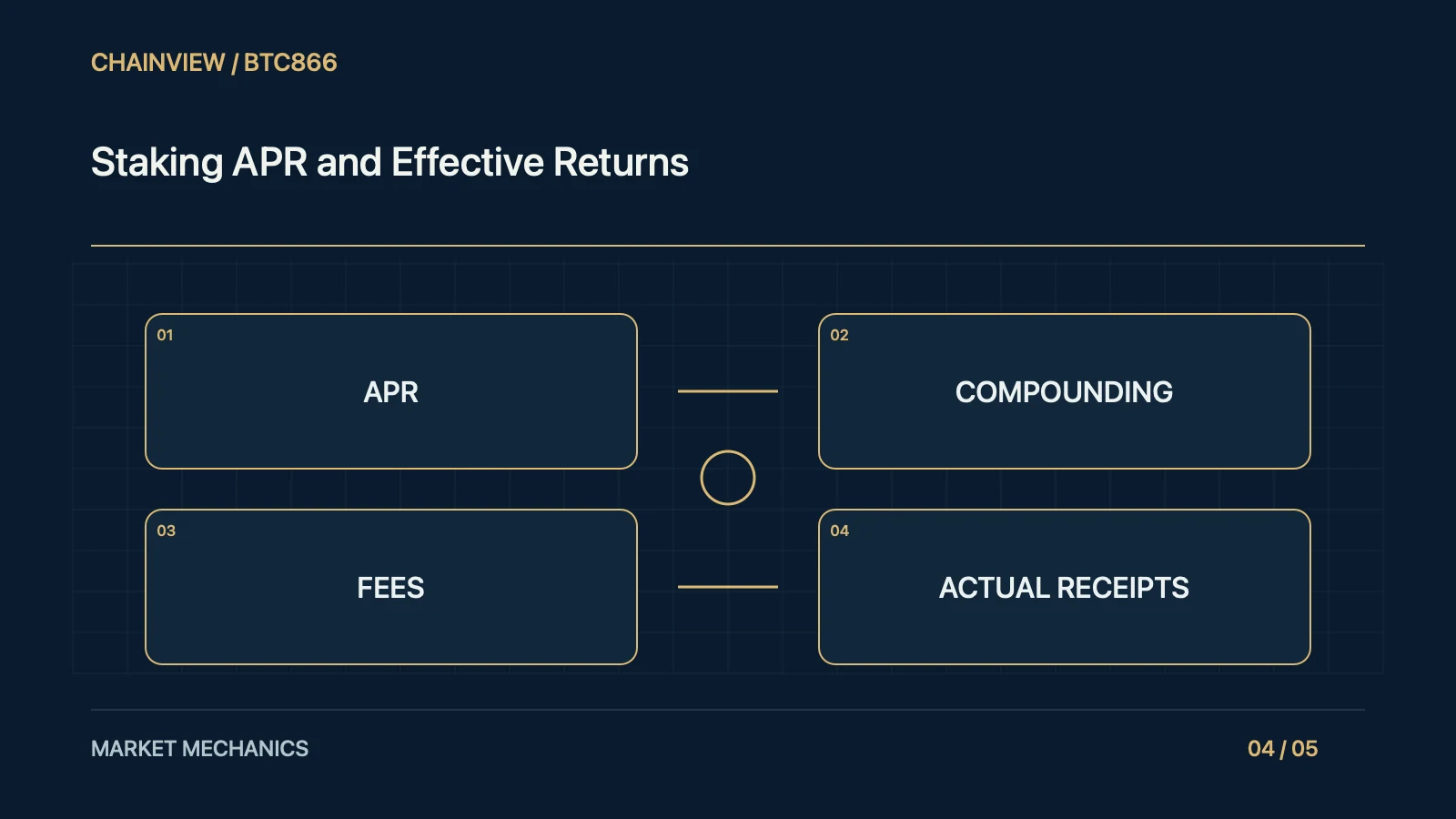
APR commonly expresses a simple annualised rate, while APY incorporates a specified compounding assumption. A provider's own definitions still need to be read. If rewards cannot be reinvested immediately, a minimum stake applies, or each reinvestment costs money, the displayed APY may not be operationally achievable. Distinguish a historical observation, a current estimate, and a promotional maximum. Multiplying a short period by a year does not establish a future annual outcome. Record the asset unit, observation window, fee treatment, and compounding schedule. Staking is not automatically a fixed deposit, and receiving rewards in the same token does not remove principal, operational, liquidity, or market-price risk from the arrangement.
Separate the sources and deductions
Protocol issuance, execution-related rewards, provider subsidies, and extra incentive tokens can have different sources and end dates. Adding them into one permanent rate hides those differences. A provider can charge commission, operating fees, or exit charges, and the fee base may be gross rewards, balances, or a particular income stream. Check the exact calculation. Incentives that are locked, thinly traded, or unavailable for sale do not equal immediately usable cash. Preserve reward quantities, claim status, valuation sources, and charged fees as separate fields. Show native-token results separately from results in a household reporting currency. A rising token price can conceal a quantity loss, while a falling price can conceal the fact that protocol rewards were actually paid.
State every condition in the example
Assume a fictional stake of one hundred units earns a constant simple annual rate of five percent for an entire year, with no fees. The teaching result is five reward units. Monthly compounding requires each monthly reward to become available and be reinvested promptly under the same assumed rate and rules. The formula cannot establish that those conditions will exist. If a ten-percent reward commission is added, calculate the deduction according to its actual fee base rather than subtracting an arbitrary number of percentage points. These values are not current offers from any project. Compare gross, net, claimable, claimed, and reinvested amounts explicitly so that mathematical precision is not mistaken for a promise.
Queues and penalties affect the outcome
Entry and exit can involve queues, and the time when rewards stop can differ from the time when funds become transferable. Downtime, reduced participation rewards, penalties, slashing, software defects, and provider failures can change realised results. Their relevance depends on the protocol and the custody arrangement. A liquid-staking token can also trade at a discount to its associated claim, so selling quickly is not identical to redeeming at an assumed face value. Inspect validator responsibilities, contract permissions, upgrade control, withdrawal paths, and the user's options during an incident. A claim of guaranteed returns needs specific verifiable legal and financial support; a familiar brand or a stable historical chart does not supply that support.
Reconcile the advertisement with actual records
Maintain a schedule of starting stake, entry date, queue days, each reward, fees, reinvestment, exit request, and ending quantity. Use the actual exposure interval and distinguish unpaid estimates from receipts. Cross-border users should retain reward timestamps and valuation evidence for advice under their own tax circumstances. When a provider changes commissions, queues, eligibility, or an incentive programme, update comparison tables and article text together. The useful conclusion is not simply which displayed percentage is largest. It identifies which portion has been observed, which portion depends on a future assumption, and which operational or market conditions can make the amount ultimately received differ from the dashboard's annualised display.
An exit comparison should include whether rewards continue during the queue and the conversion cost after assets return. Two advertised annual rates are not directly comparable when funds remain inaccessible for different periods. Keep the requested exit time, reward cutoff, claimable time, and actual transfer time separately. Those operational timestamps explain realised outcomes better than a headline percentage alone.