Original topic illustration: ChainView BTC866 original topic diagram · ChainView BTC866 Editorial · CC BY 4.0
Mechanism and rights
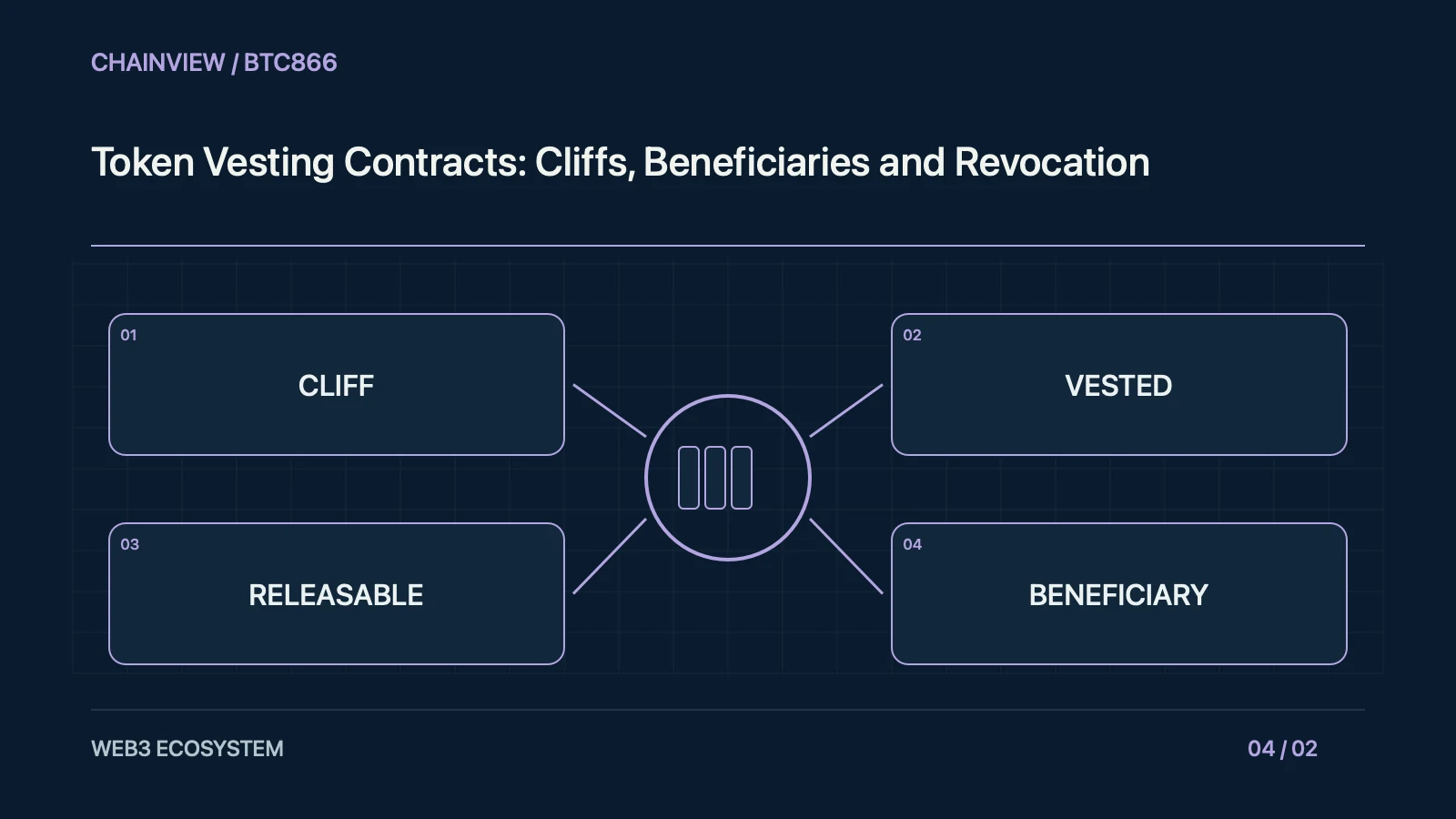
A vesting arrangement can use a cliff, linear release, milestones, or revocation conditions. A calendar alone cannot establish that tokens are freely circulating. Vested, claimable, transferred, and sold are separate events, while legal ownership may be governed by another agreement. Read the start, duration, time source, rounding, and applicable date boundary. A dashboard's quantity should identify which of these states it describes rather than relying on the broad word unlocked.
Draw a timeline containing start, cliff, end, and previous claims in one stated time zone. Do not merge the vesting time with the first tradable time. If a milestone requires human approval, identify that approver and any dispute mechanism. A conditional business decision should not be illustrated as if a deterministic clock alone releases the allocation.
Records and verification
Inspect the token contract, beneficiary, funding balance, administrator, and upgrade controls. Confirm that the published address is the relevant deployed arrangement. A schedule promising one million units does not show that sufficient tokens were funded. Compare available balances with obligations. Proxy upgrades, pausing, beneficiary changes, and revocation can alter restrictions, so list who controls them. Describing an allocation as locked without naming those powers can imply stronger enforcement than the evidence supports.
When checking funding, distinguish the intended native token from lookalikes or wrapped representations and use the correct decimals. An administrator's ability to add funds does not prove that funding will arrive on time. Record unfunded obligations explicitly. A promise of a later deposit cannot silently offset a current shortfall in the balance available to satisfy the published schedule.
Worked limits and controls
Consider a fictional one-thousand-unit allocation over twelve months with a three-month cliff. Before the cliff there may be no claimable amount, but afterwards the arrangement might catch up accrued vesting or use another formula. Only its actual code and terms answer that question. These figures are not a project's current schedule. Deduct earlier payments when calculating the remaining claim, and check whether time is counted continuously or by discrete periods. A familiar chart cannot resolve implementation details.
Test boundary times before the start, around the cliff, and after the end, comparing cumulative vested value with currently claimable value. Rounding can leave residual units, whose treatment should be documented. One example in the middle of a month does not establish correct behaviour at every boundary. A harmless calculation sheet can reveal assumptions without interacting with the production contract.
Exceptions and actions
Employment, investment, or service agreements can add off-chain conditions. A blockchain transfer alone does not establish that every legal obligation ended. Assets described as locked but movable through an administrator or upgrade have a different economic constraint from an immutable funded schedule. Report source evidence and undisclosed terms explicitly. Do not infer that every beneficiary will sell on an unlock date. Released quantity is not identical to new market selling, and a contract balance is not automatically unencumbered property of one party.
Where contractual terms are private, report that off-chain conditions could not be confirmed rather than inventing them. A beneficiary address is not automatic proof of its ultimate controller. Be careful with identity inferences from public transaction links, especially when they could expose individuals. Separate a demonstrated transfer from an unverified claim about who beneficially owns or controls the receiving account.
Ongoing maintenance
Maintain a ledger of schedule versions, funding, claims, revocations, and beneficiary changes. Reconcile opening balance plus funding minus releases with the closing balance. An unusual notification should prompt address and permission checks rather than a test transfer into an unknown contract. Updates should distinguish the original timetable from actual execution and explain differences that can be verified. Readers then see the enforcement mechanism and outstanding questions instead of treating a dramatic unlock percentage as a complete description of rights or market pressure.
Place actual releases beside the announced schedule and mark advances, delays, or revocations with sources. Event names are developer-defined and still need interpretation through amounts, recipients, and code. An event labelled release does not excuse ignoring the real asset movement. Preserve raw transaction references so a later correction can revise the explanation without losing the evidence behind the original report.