Original topic illustration: ChainView BTC866 original topic diagram · ChainView BTC866 Editorial · CC BY 4.0
Spread as an immediate cost
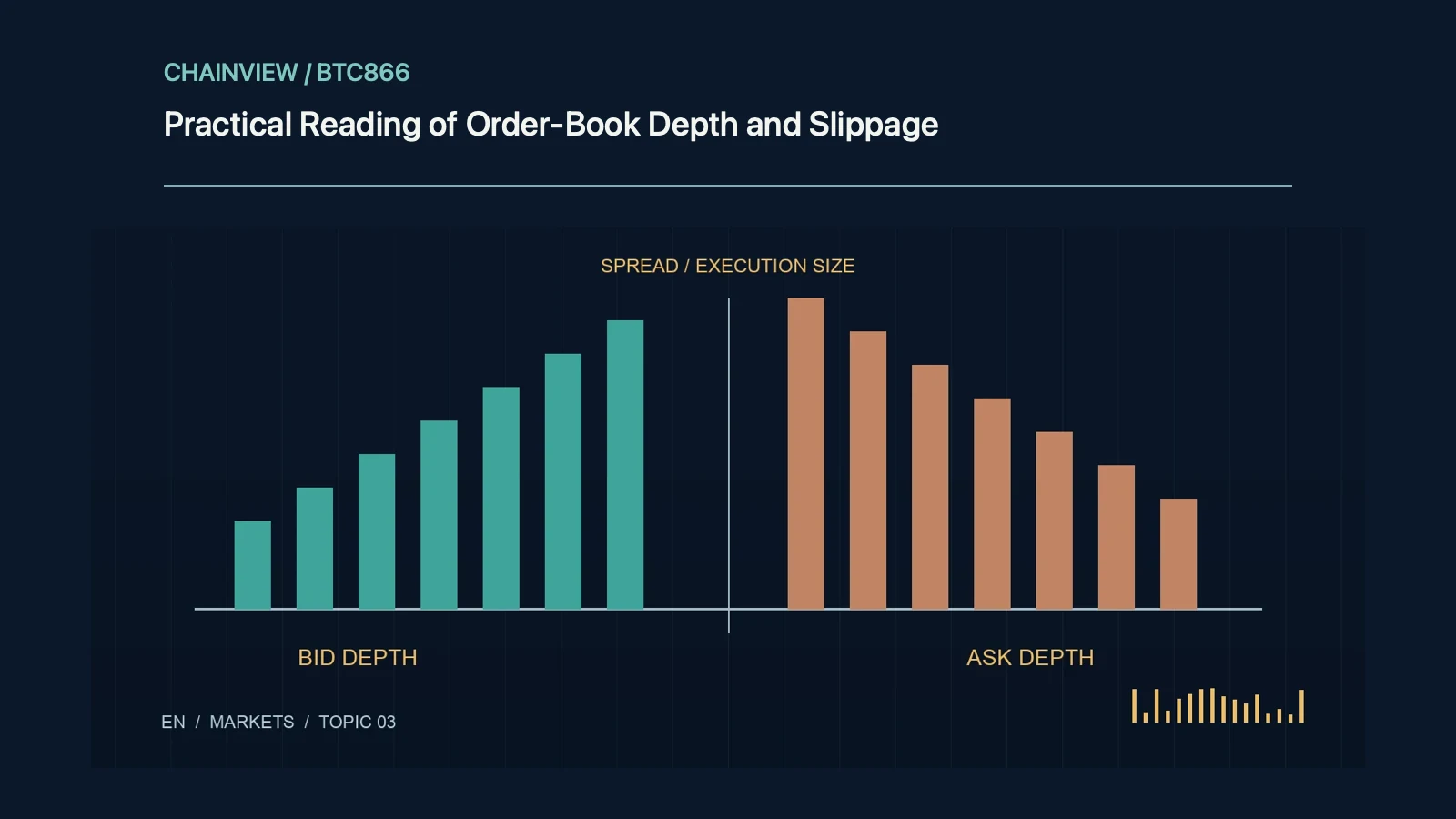
The best bid-offer spread is an immediate trading friction. Normalize quote currency, units, and timestamps across venues. Keep absolute and percentage spreads. A small quantity at the best price says little about the cost of a large order, and displayed liquidity may disappear before an order reaches the matching engine.
Depth and average execution
Estimate a market buy by accumulating offers until the target quantity is covered, then compute the quantity-weighted average price. Do not average price levels equally. Depth is a snapshot rather than guaranteed execution. Compare the estimate with actual fills and retain latency and market-movement information when diagnosing differences.
Define the slippage benchmark
Choose the benchmark before measuring slippage: decision price, arrival midpoint, or best quote. Report fees separately. Retain expected price, send time, fill time, and costs. Include favorable execution as well as unfavorable slippage; otherwise a sample can exaggerate execution quality problems or conceal them.
Limit-order trade-offs
A limit controls acceptable price, not execution certainty. Queue position, partial fills, and adverse selection matter. Understand time-in-force settings such as immediate-or-cancel and fill-or-kill before use. Verify fees for the specific market and account tier instead of assuming that every resting order is free.
Volume is not executable depth
Historical volume does not equal current executable depth. Automated activity, cancellations, and reporting methods can inflate impressions of liquidity. Compare estimated slippage for the same order size across several times, and read outage, price-limit, and erroneous-trade rules. A volume ranking alone cannot establish resilient execution.
Keep an execution record
Record venue, side, quantity, book timestamp, fee tier, order type, and individual fills. Staging can reduce immediate impact while increasing time exposed to price changes; amendments can lose queue priority. Separate market movement, shallow depth, and latency in the review. Past favorable execution is not a future guarantee.
Worked review example
Suppose offers show two units at 100 and three at 101. Buying four units consumes two at each price, for an average of 100.5 before fees. A larger order would use different weights, so averaging displayed levels equally is generally wrong. If liquidity cancels before arrival, execution can cost more. Preserve the initial book, request time, and fills, then calculate estimated impact, realized slippage, and fees separately. The numbers are hypothetical and do not describe an available market. They illustrate why an execution review needs quantities, timestamps, and the chosen benchmark in addition to prices.