Original topic illustration: ChainView BTC866 original topic diagram · ChainView BTC866 Editorial · CC BY 4.0
Define what is being decided
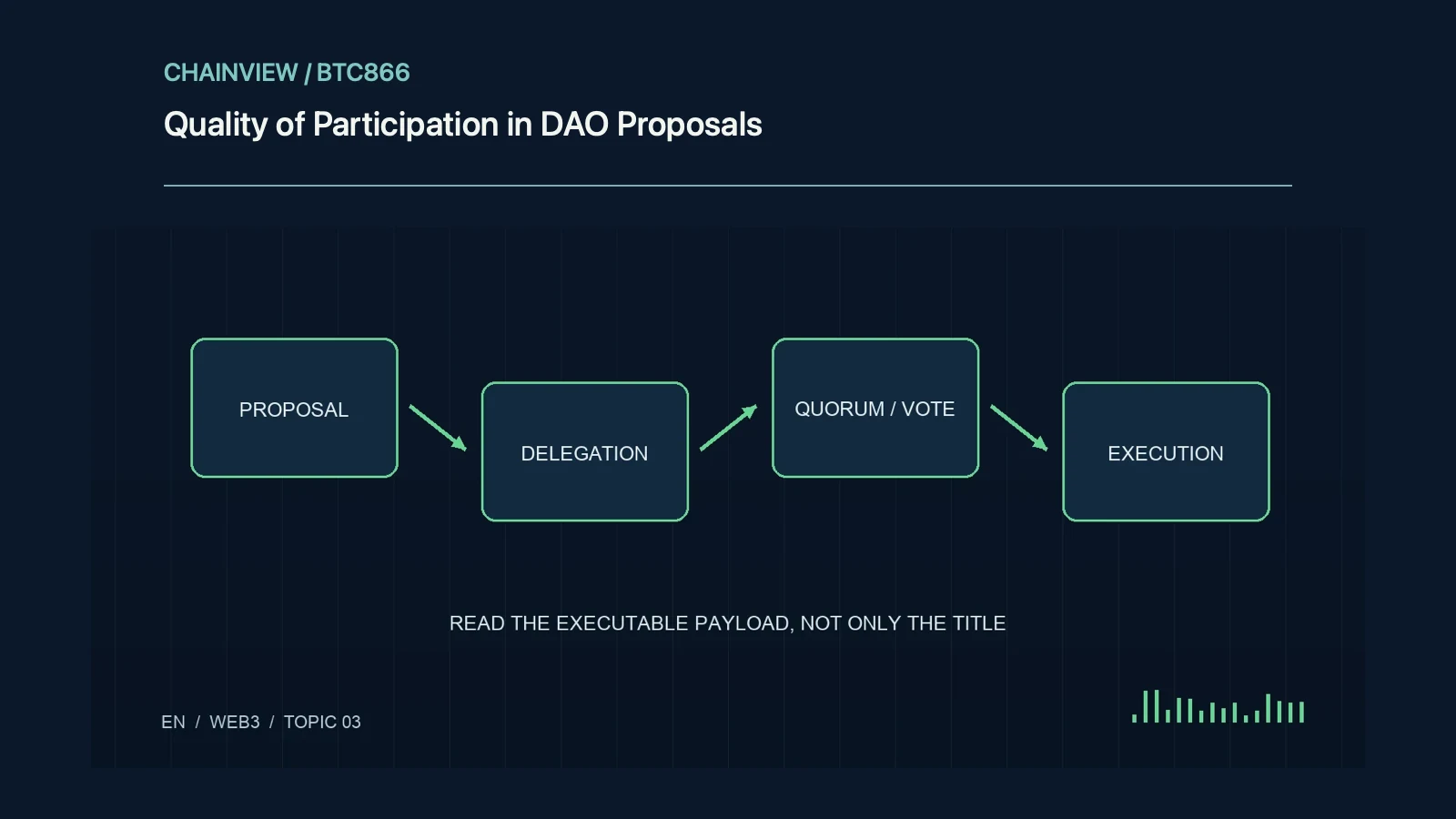
Distinguish temperature checks, binding votes, and queued execution. Read identifiers, full text, discussion, code, and budgets. Social polls may have no governance force. A majority can still miss quorum. Evaluate participation against the actual decision mechanism rather than interpreting an isolated approval percentage as a completed organizational action.
Sources of voting power
Voting power may derive from snapshot balances, lock duration, delegation, or membership. Check treatment of borrowed tokens, receipt assets, and post-snapshot transfers. Address counts are not participant counts. Distribution data can reveal concentration, but cannot fully establish common control or off-chain coordination among apparently separate voters.
Quorum and approval thresholds
Quorum can use participation, affirmative votes, or eligible supply; abstentions may be treated differently. Recalculate one result numerically. Inspect proposal rights, cancellation, voting periods, and who can change the rules. A displayed threshold is not permanent if another authority can modify the underlying governance contract or settings.
From prose to execution
Compare executable calls with the prose: targets, functions, amounts, upgrades, and allowances. Check timelocks and execution windows. Approved budgets are not necessarily disbursed, and failed execution does not erase the vote. Link the proposal result, queue transaction, and execution transaction so the full decision chain can be audited.
Delegation and conflicts
Review delegate records, compensation, affiliations, and revocation procedures. Published reasoning improves transparency but does not eliminate conflicts. Check disclosures and recusal where recipients vote on their own budgets. Participation quality includes informed discussion, intelligible reasons, and continuing accountability rather than simply maximizing the raw number of votes.
Safety before participation
Governance interfaces can be spoofed. Verify domain, network, message type, and requested permissions. Ordinary voting should not require disclosing recovery phrases or sending funds to a private address. Preserve proposal versions and follow execution reports. Voting power does not automatically constitute equity or legal membership; legal treatment depends on structure and jurisdiction.
Worked review example
Suppose sixty votes support and forty oppose, but quorum requires 150 eligible votes. Sixty-percent support is insufficient. Check whether abstentions count, then distinguish quorum, approval, and execution. Compare budget recipients and queued calls with the proposal. A successful vote display does not establish that money was paid or that every executable instruction matched the prose.