Original topic illustration: ChainView BTC866 original topic diagram · ChainView BTC866 Editorial · CC BY 4.0
Mechanism and observed state
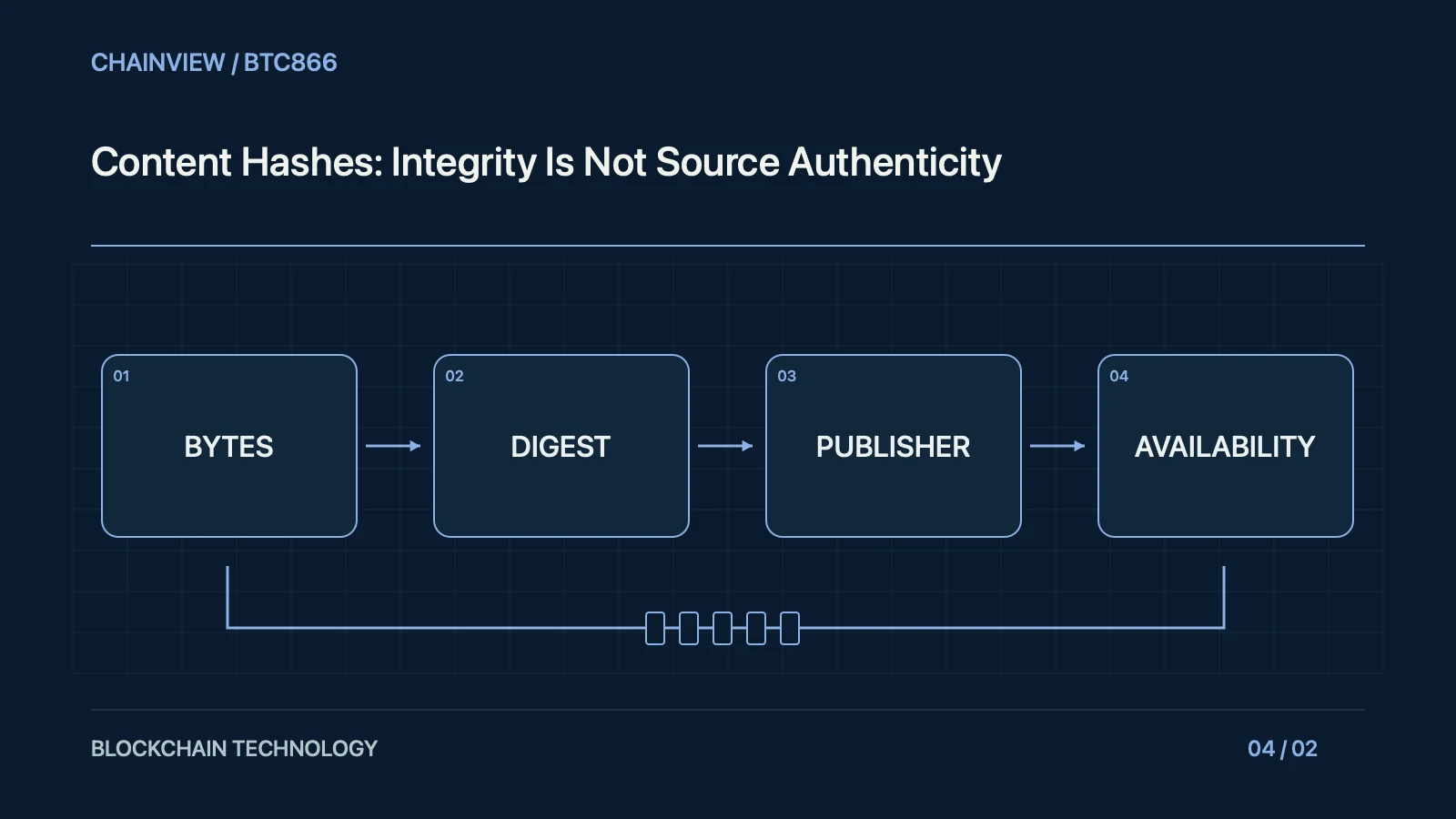
A cryptographic digest maps bytes to a compact value and helps test whether a download matches an expected object. It does not establish that the publisher is trustworthy. An attacker can publish a matching checksum for a malicious file, so authenticate the channel carrying the expected digest first. Filenames, icons, and download-button styling are not integrity evidence. Save the expected algorithm, digest, file length, and exact verification target.
Algorithm choice, decompression, and newline conversion affect the verification target. Checking an installer archive is different from checking an extracted executable, and a downloader that recompresses content can change bytes. Follow the release instructions for the same object before interpreting a mismatch. Otherwise a correct calculation can answer a different question from the publisher's checksum.
Validation workflow
Content identifiers can contain version, codec, and multihash information. A textual difference does not always mean that the underlying content differs. An IPFS CID can identify an encoded data structure, while chunking, directory structure, and paths affect what is addressed. Establish whether a tool compares a raw file, a block, or a directory before interpreting its output. Use compatible documented tools rather than reducing every comparison to identical strings.
For CID comparisons, retain the representation and tool output rather than comparing casually normalised URL text. A file within a directory and the directory root identify different objects. Demonstrate the path hierarchy in a harmless example, and explain whether a tool resolves content or compares identifiers. This avoids treating an encoding or navigation difference as proof of tampering.
Authority and execution limits
A gateway serving an object demonstrates current availability through that gateway, not authorship, copyright permission, indefinite retention, or safe execution. Content addressing and durable storage are separate concerns. Important records still need an appropriate backup and retention plan. A displayed link can redirect, so retain the final URL, CID, file size, retrieval date, and any transformations applied. Otherwise a later reviewer may unknowingly verify a different object from the one originally used.
Long-term availability needs an operational owner, retained copies, and a way to detect loss. A public gateway that serves an object today does not necessarily undertake archival duties for the reader. Preserve important notices within lawful use and retention requirements, identifying the original publisher. Integrity and availability checks should appear as separate items in an archive-maintenance plan.
Diagnosis and testing
A signature associates content with a key under a verification scheme, but the key's identity, revocation status, coverage, and trust policy still matter. Downloading a file, digest, and unfamiliar public key from the same suspicious page does not independently authenticate the publisher. Where the project supports it, compare the key fingerprint through an established independent channel. Preserve verification output and tool versions, and explain whether the signature covers the archive, installer, manifest, or a narrower component.
A signature failure can result from corruption, the wrong public key, incompatible formats, or an invalid signature. Investigate the actual output rather than substituting random keys until a tool shows green. Establishing key identity is not an optional cosmetic step. Where the publisher documents key rotation, retain the authenticated transition evidence and the date to which it applies.
Outcome and evidence
A harmless text file provides a useful exercise: compute its digest, change one character, and verify again. There is no need to execute an unknown binary to learn integrity checking. For financial software, assess source, integrity, requested permissions, and intended use separately. Passing a checksum test does not justify entering a recovery phrase, granting trading authority, or running an administrator command. An untrusted file should remain unexecuted even when its bytes match an untrusted publisher's own checksum.
A verification log should include time, tool version, input filename and size, and expected versus observed values, while excluding private keys and account secrets. Share only the necessary portions with support. Public release data and personal device paths have different privacy implications. A reproducible log provides useful evidence without turning a routine checksum question into an unnecessary disclosure of unrelated information.