Original topic illustration: ChainView BTC866 original topic diagram · ChainView BTC866 Editorial · CC BY 4.0
Mechanism and rights
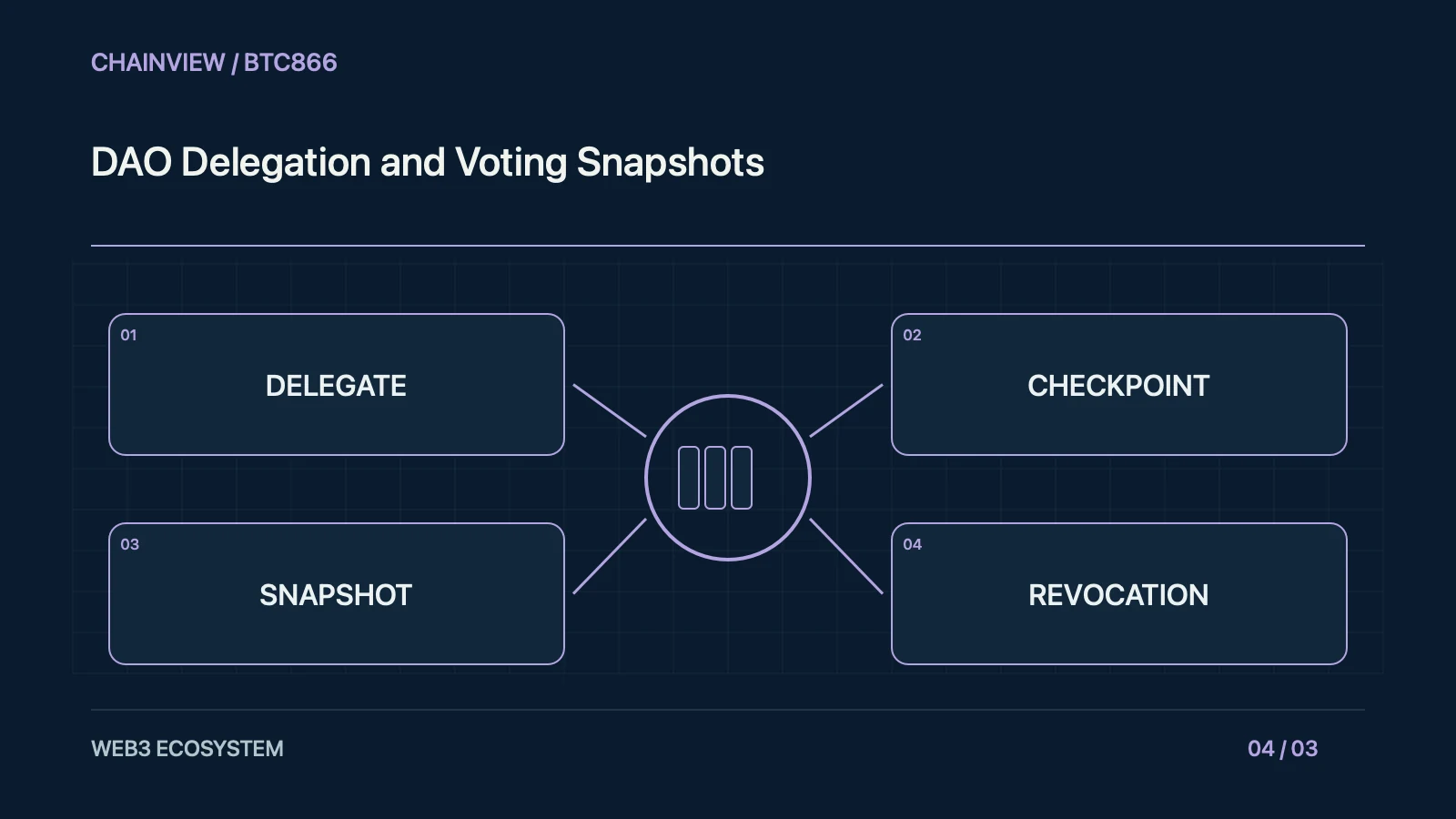
DAO delegation often assigns voting power without transferring token ownership, but the actual token and governance modules determine the rule. Protocols differ on on-chain transactions, signed delegation, self-delegation, and activation. Confirm the network, token, and governance contract. A wallet balance need not equal currently usable voting power. Reading an asset screen alone cannot establish proposal eligibility, especially where delegated balances and historical checkpoints matter.
Read how voting power is created before participating. Some token designs require delegation before checkpoints are recorded, while others follow different mechanisms. A larger balance without matching historical weight can be an intended rule rather than a software defect. It certainly does not justify transferring tokens to a stranger who claims to refresh or activate the account's governance power.
Records and verification
Checkpoints preserve historical voting weight, and a proposal snapshot can use a block-height or time-based clock. Delegation or a transfer after that snapshot may not change the proposal's weight. Record the proposal ID, snapshot, voting start and end, and the confirmed status of a delegation. Submitted and effective are different states. If an interface lags, inspect the documented contract state rather than repeatedly moving tokens or paying additional fees to refresh an uncertain display.
If the governance clock differs from the block display, use the module's documented clock semantics. Cross-chain proposals add transmission and execution stages, so a source-chain vote ending does not establish a changed destination state. Record each stage and its reference. A timeline should show what was decided, queued, delivered, and executed instead of compressing those events into one success label.
Worked limits and controls
Suppose a fictional proposal takes its snapshot at block one thousand and a user delegates at block one thousand five. The delegate's current weight may increase without affecting that proposal. The exact before-or-after semantics still depend on implementation. Revoking, changing delegates, and voting directly can interact differently and can apply only to future proposals. A tutorial should name the protocol it demonstrates instead of presenting one implementation as a universal DAO rule.
Before changing delegates, confirm revocability, cost, and effective scope, retaining old and new delegates and the confirmation block. Whether direct voting overrides delegated power depends on the protocol. Do not promise that one click withdraws a representative's already cast vote on an older proposal. Explain what the user can control now and which historical snapshot or ballot is already fixed.
Exceptions and actions
A delegate's voting history, compensation, affiliations, and conflict disclosures are more informative than a popularity rank, but none promises future independence. Check quorum calculation, abstention treatment, approval thresholds, and execution delays. The option with the most votes may still fail a threshold. Even a passed proposal can await a timelock, administrator, or cross-chain execution. Do not report the end of voting as proof that a change has already taken effect in production.
A disclosure table can include delegate compensation, affiliations, holdings, and stated reasons while leaving unknown fields unresolved. Low participation can reflect absence, eligibility, or timing and should not be interpreted without evidence. Rankings are not moral scores. Readers benefit from verifiable behaviour and explicit conflicts more than an unsupported assertion that a popular delegate will always act independently or follow every delegator instruction.
Ongoing maintenance
Retain the delegate, authority, expiry if any, revocation route, and proposal history, and periodically assess whether the representative still matches the user's preferences. Delegation should not require handing over recovery words or sending tokens to an individual's claimed voting address. Where an interface conflicts with contract records, preserve evidence and ask through official channels. Distinguish weight, voting, and execution in updates. That separation keeps governance participation understandable without turning a ranking or a successful delegation transaction into a guarantee of responsible representation.
After voting, check thresholds, timelock entry, execution status, and any cancellation path. Preserve the result version and subsequent updates. This connects governance commitments with actual deployment and helps readers distinguish a social-media poll from a binding protocol process. A completed vote is one milestone, and its reported effect should remain conditional until the relevant execution evidence is available.