Original topic illustration: ChainView BTC866 original topic diagram · ChainView BTC866 Editorial · CC BY 4.0
Define the peak and trough
Drawdown is measured from a previous high. Its maximum depends on the period and sampling frequency, so daily closes may miss an intraday trough. Fix the valuation currency and price source before comparing assets.
Keep native-asset and home-currency values side by side. A continuous market and a dataset sampled only on business-day closes do not provide identical drawdown observations. When intraday coverage is incomplete, describe the result as based on available samples instead of claiming to have measured every price excursion.
Drawdown measures decline from a prior high, while maximum drawdown depends on the observation period and sampling frequency.
Change the recovery denominator
A hypothetical balance falling from 100 to 50 loses 50 percent, but rising from 50 back to 100 requires 100 percent. Fees and other costs can raise the actual recovery requirement. These figures illustrate arithmetic, not expected returns.
The recovery formula uses remaining capital as its denominator. Required gain rises faster as the loss deepens. Do not add percentages mechanically or treat a new contribution as recovery of the old funds. Preserve unrounded calculations and apply a consistent display precision only at the presentation stage.
A 50 percent loss requires a 100 percent gain to recover before fees; a recovery percentage uses the lower post-loss base.
Separate external cash flows
A deposit can lift a balance without investment profit, while a withdrawal can reduce it without a trading loss. Reconcile internal wallet movements separately. Recovery in dollars and recovery in a resident's home currency may occur on different dates.
Rewards, airdrops and asset splits can change unit counts and need separate classification. Without cash-flow timestamps, precise portfolio drawdown may not be reconstructable. Label a provisional result rather than assuming every deposit happened at the period's start merely to make a clean chart.
External deposits, withdrawals and the chosen valuation currency can distort a portfolio balance chart, so separate investment performance from cash flows.
Measure time below the high
Two portfolios can have the same maximum drawdown and very different recovery durations. Record the first decline, trough and return to the prior high. Leave an unfinished recovery open rather than selecting only assets that eventually recovered.
Add time underwater and an unrecovered flag to a table. Stopping observation truncates recovery duration, and assets that never regain a high must remain in the sample. Incomplete early price history can hide a prior peak, so explicitly state that boundary as well.
Use hypothetical paths to compare recovery time and capital needs; historical drawdown is not a guaranteed floor for future losses.
Use history as evidence with limits
The worst observed decline is not a guaranteed future loss limit. Compare hypothetical paths against household cash needs and possible forced withdrawals. A recovery scenario should explain funding pressure rather than promise that patience will necessarily restore principal.
For a household requiring monthly withdrawals, the path changes even if market prices eventually recover: fewer units may remain. State the withdrawal rule and cost in a stress scenario, assessing whether expenses can be met rather than promising a future waiting period based on past recovery times.
A final audit can reproduce one peak-to-trough segment manually from the retained prices. Verify that the peak occurs before the trough and that the recovery calculation uses the same currency. If a withdrawal occurs between them, show its treatment explicitly. This small check catches a common spreadsheet error: choosing the minimum and maximum anywhere in the period without respecting order, which can report a path that no investor actually experienced.
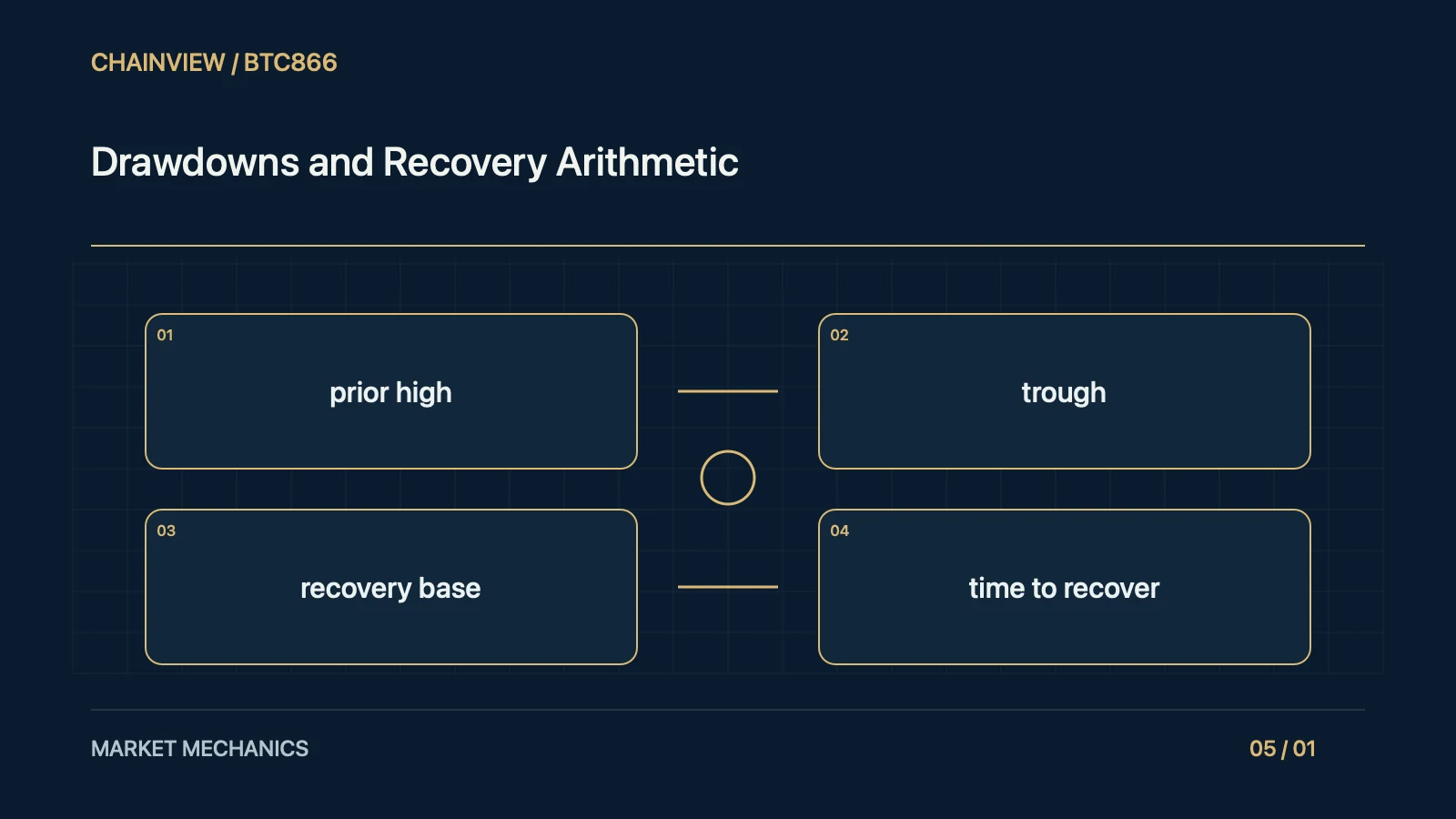
A useful worksheet for this topic has separate entries for prior high, trough, recovery base and time to recover. Fix one set of fictional inputs, change one condition at a time and identify which conclusion moves. Retain units, observation time and source beside every number. An unknown input should remain unknown rather than becoming zero by default. The purpose is to expose methodological dependence, not select the most flattering outcome. Before using the result for a real-money decision, compare its assumptions with actual fees, available liquidity, household spending needs and the loss the user can afford. A clean calculation cannot remove those constraints.