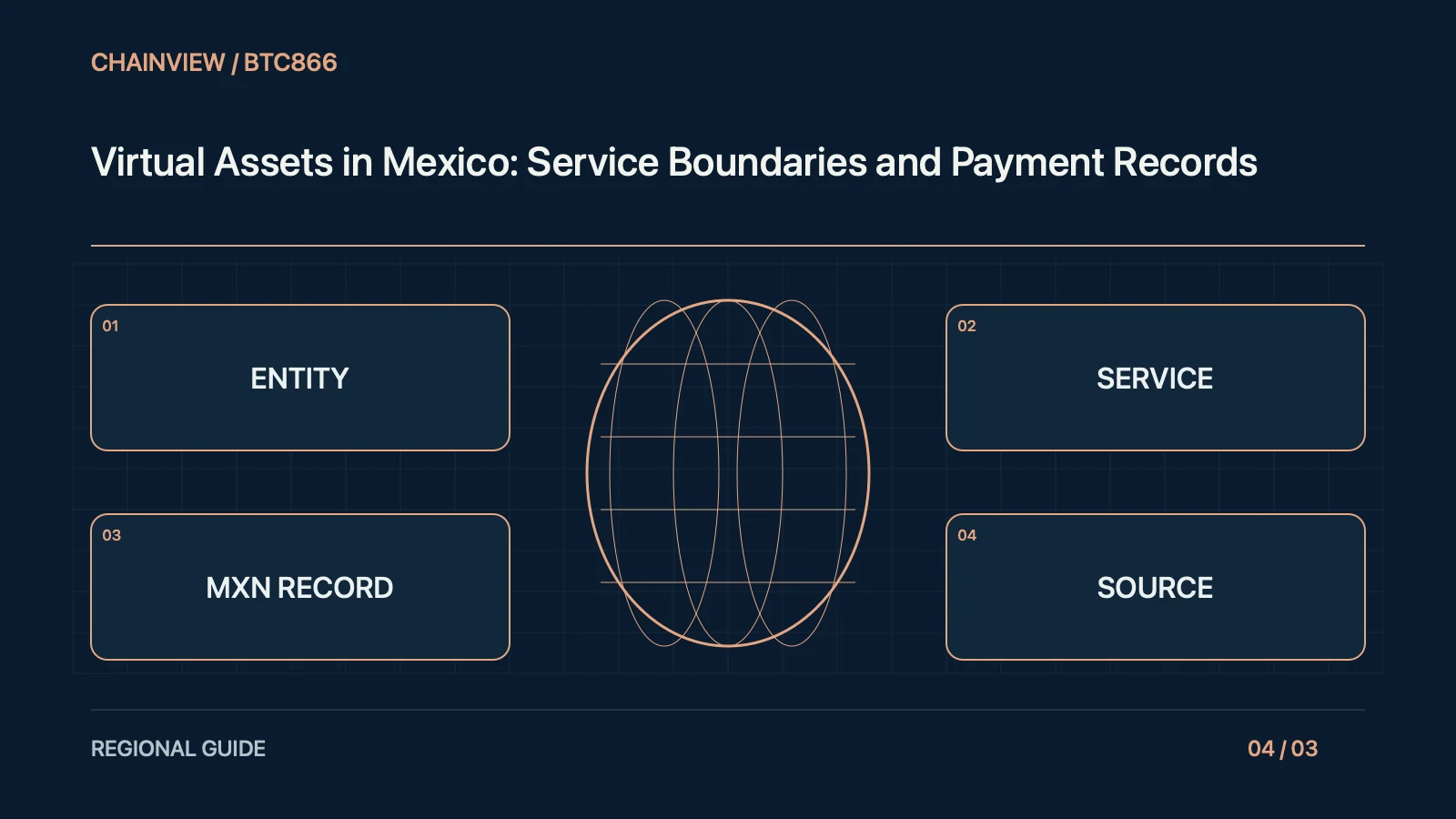
Original topic illustration: ChainView BTC866 original topic diagram · ChainView BTC866 Editorial · CC BY 4.0
Distinguish categories and perimeters
Virtual assets, legal tender, bank deposits, and regulated payment services are different legal categories. In Mexico, paying in pesos does not automatically make a product a bank deposit or give it the same protections. Identify whether the customer acquires a token, custody claim, payment balance, or another service before reviewing the contracting entity, activity, and current Spanish-language materials. A convenient payment route does not settle the legal classification.
Use the full entity name and activity when searching official records instead of substituting an app name. If a record describes a payment function, describe only that scope. The same promotional page advertising tokens does not prove that both functions fall within one authorisation. Separate the legal evidence for each activity, even where the interface makes them appear to be one seamless customer experience.
Verify current records
Banco de México, CNBV, and consumer authorities have distinct responsibilities, and registrations or authorisations have defined scopes. A fintech authorisation should not be extended into official approval of every crypto activity. Match promotional regulatory claims to public records field by field: legal name, status, permitted activities, restrictions, and official domain. Retain the query date. An entry does not guarantee investment quality, price, uninterrupted access, or recovery if a transaction goes wrong.
Consumer-protection and financial-supervision materials can serve different purposes. The existence of a complaint route does not establish that every loss will be compensated. Check covered customers, institutional roles, and process limits, preserving the original wording. Translation should not turn complaint assistance into a financial guarantee or describe an informational notice as a product-specific endorsement by an authority.
Read applicable terms
Local and overseas users should verify residence, customer category, charges, supported networks, and dispute procedures. A familiar brand can contract through different entities, so its logo does not identify the responsible legal party. Translate Spanish terms for payment, deposit, custody, and virtual assets separately rather than turning marketing language into a legal conclusion. If scope remains unclear, seek an official written explanation before assuming that a service is available or protected.
A cost table should separate spreads, transfer charges, withdrawal fees, and conversion costs, clearly labelling MXN and token units. A stable-looking peso display does not remove the token's market risk. Payment convenience and investment exposure are separate assessments. Compare actual transaction records with the fee description rather than assuming that the absence of a prominently displayed commission means the service has no economic cost.
Keep personal evidence
Keep MXN amounts, fees, exchange rates, conversion times, bank references, and blockchain hashes in separate fields. A successful bank payment does not prove that a blockchain asset has been credited. Cross-platform transfers need matching entities and networks, plus a support record for any missing credit. Do not make duplicate payments as a test. If another currency is displayed, preserve its source and time rather than applying today's rate retrospectively without explaining the conversion method.
Bank references and blockchain hashes belong to different systems. Connect payer, provider, and destination through the available evidence. If a platform offers only an internal ledger reference, disclose that limitation rather than inventing a blockchain identifier. Keep a support case for differences and stop duplicate payment attempts. A bank debit can be genuine while the related asset credit remains delayed or disputed.
Maintain and seek qualified review
Tax consequences depend on personal facts and current rules; this article does not determine a filing position. Preserve original Spanish notices, contract versions, and payment evidence for qualified local review when needed. Updates should distinguish regulatory records, customer eligibility, and actual transaction outcomes, correcting obsolete terms promptly. That approach gives readers a practical evidence trail without presenting one authorisation as a comprehensive endorsement of every virtual-asset product or transaction connected to a brand.
A cross-border account may contract with a different entity and terms. Do not apply a Mexican local notice automatically to every Spanish-speaking customer. State query date, region, and version in maintained articles and correct excerpts after changes. This keeps older promotional language from circulating as current legal guidance and gives readers a way to verify which rule actually matches their own service relationship.