Original topic illustration: ChainView BTC866 original topic diagram · ChainView BTC866 Editorial · CC BY 4.0
Inventory from imbalanced flow
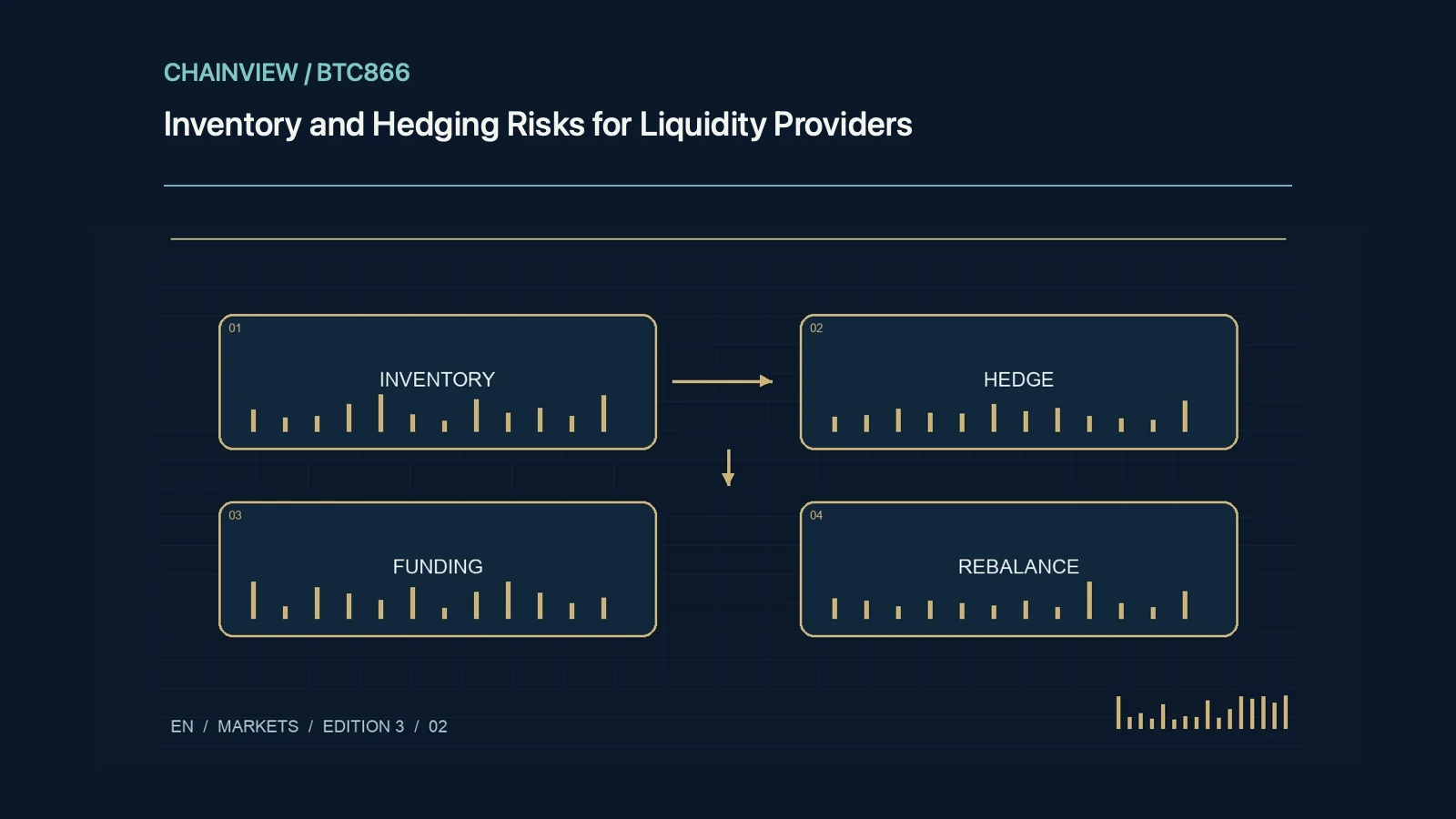
Liquidity provision creates inventory when trading is one-sided. Fee income does not imply neutrality: inventory losses can exceed collected fees. Record starting assets, quote range, limits, and reporting currency. Order-book market making and AMM pools have different mechanics. A pool can rebalance holdings automatically as prices move, so a return comparison must account for the actual evolving asset mix rather than assuming quantities remain fixed.
Hedging adds dependencies
Futures or cross-venue hedges can reduce one exposure while adding basis, funding, margin, and counterparty risks. Proxy hedges depend on correlations. A halted venue can leave the other leg trading. Record hedge ratios, rebalancing rules, collateral, and liquidation mechanics. Economic offset across accounts does not guarantee each account remains solvent; a margin call can close one leg even when aggregate mark-to-market appears nearly neutral.
Fees versus net returns
A net result includes fees, incentives, inventory changes, hedge P&L, financing, gas, and rebalancing. Incentive tokens need realistic prices and lock-up assumptions. Concentrated liquidity can stop earning outside its range and incur repositioning costs. Use an explicit benchmark, such as passive holding of the same initial mix. Currency and period choices can reverse apparent performance, so publish assumptions alongside the return curve.
Inventory budgets under stress
Stress simultaneous one-way flow, weaker hedge liquidity, funding spikes, collateral haircuts, and withdrawal pauses. Estimate inventory, usable margin, and exit time, with named authority to reduce or stop quoting. One hundred of fees against a thousand of inventory loss is not a successful fee result. Scenarios cannot guarantee executable exits, especially when correlations shift; budgets and documented controls matter more than headline annualised yields.